 Mushie
Field mushroom vs Destroying angel: how to tell them apart
The destroying angel is a deadly all-white Amanita that is sometimes mistaken for a white field or button mushroom. A destroying angel has pure white gills at every stage of life and a sac-like cup (volva) at the base of the stem. A true field mushroom has pink gills when young that turn chocolate-brown with age, and no cup at the base.
Side-by-side comparison
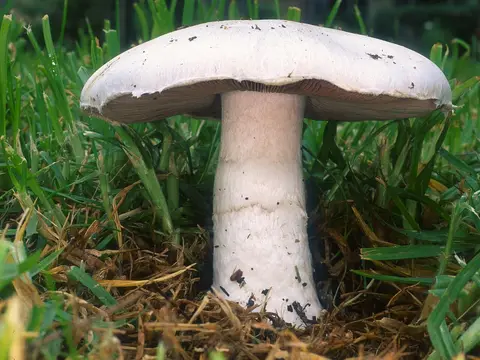 Agaricus campestris | 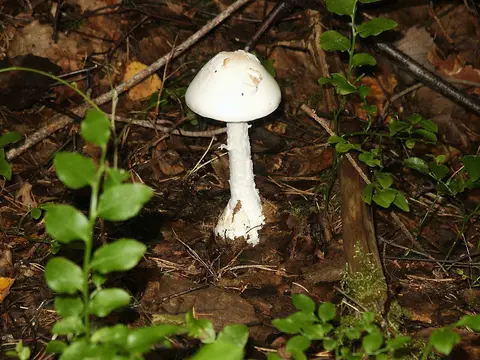 Amanita virosa | |
|---|---|---|
| Safety status | Edible (expert ID) | Deadly |
| Cap | White, 3–10 cm, dry, smooth to finely scaly | Pure white, conical to bell-shaped, 5–10 cm, smooth |
| Underside | Pink when young, chocolate-brown when mature, never white | White gills, free from the stem |
| Stem | Short, white, with a thin, fragile ring | White and shaggy, with a delicate ring and a loose sac-like volva at the base |
| Smell | Pleasant, mushroomy | Sickly sweet, unpleasant with age |
| Spore print | Dark brown | White |
| Habitat | Grazed pastures, meadows and lawns | Damp conifer and mixed woods, often with birch |
| Season | Aug – Oct | Jul – Oct |
Photos: Wikimedia Commons contributor, CC BY-SA 3.0 · en:User:Ben DeRoy, Public domain


Quick tests that separate them
- Gills: pink turning chocolate-brown (field mushroom) vs pure white at every age (destroying angel).
- Stem base: plain base in grass (field mushroom) vs buried white sac or cup (destroying angel).
- Spore print: dark chocolate-brown (field mushroom) vs pure white (destroying angel).
- Habitat: open pastures and lawns (field mushroom) vs near woodland trees (destroying angel).
Key clues for each
Field mushroom: Pink gills in young specimens and chocolate-brown in old ones, and no yellow staining at the stem base or sac-like cup at the base.
Destroying angel: An all-white mushroom with a ring and a sac at the base. Never eat a white-gilled, white-capped mushroom that you cannot rule out as an Amanita.
Frequently asked questions
How can I tell field mushroom from destroying angel?
The destroying angel is a deadly all-white Amanita that is sometimes mistaken for a white field or button mushroom. A destroying angel has pure white gills at every stage of life and a sac-like cup (volva) at the base of the stem. A true field mushroom has pink gills when young that turn chocolate-brown with age, and no cup at the base.
Which is more dangerous, field mushroom or destroying angel?
Destroying angel (Amanita virosa) is the dangerous one. Contains amatoxins like the death cap. Can cause fatal liver failure after a delayed onset of symptoms.
Is it safe to identify mushrooms from photos or a website?
Never eat a wild mushroom based on an app or a website. Confirm identification and edibility in person with a qualified local expert.
Compare in the field
Photograph your find with Mushie to see possible matches and the look-alikes to rule out. Results are suggestions, never a safe-to-eat verdict.