 Mushie
Enoki vs Funeral bell: how to tell them apart
Wild enoki (velvet shank) and the deadly funeral bell can grow on the very same log in autumn and winter. Wild enoki has a dark, velvety, ringless stem and a pure white spore print. The funeral bell has a thin ring zone on a fibrous stem and a rusty-brown spore print. Never eat any wild enoki without taking a spore print.
Side-by-side comparison
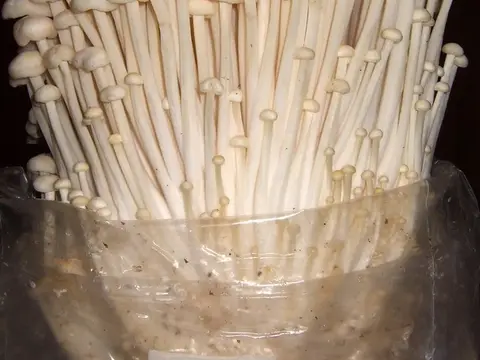 Flammulina filiformis | 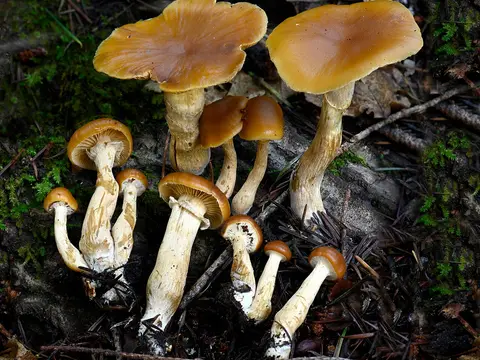 Galerina marginata | |
|---|---|---|
| Safety status | Edible (expert ID) | Deadly |
| Cap | Tiny, white to cream (cultivated), 1–3 cm, smooth | Honey to tawny-brown, 1.5–5 cm, sticky when wet, margin lined when moist |
| Underside | Cream gills | Pale, then rust-brown gills |
| Stem | Long, thin, white and velvety | Brown, fibrous, with a thin ring that often disappears |
| Smell | Mild | Mealy, like flour |
| Spore print | White | Rusty brown |
| Habitat | Cultivated in dark rooms; wild forms grow on dead wood in winter | Rotting stumps and logs, conifer and broadleaf |
| Season | Year-round | Apr – Nov |
Photos: frankenstoen, CC BY-SA 2.0 · Alan Rockefeller, CC BY-SA 4.0


Quick tests that separate them
- Spore print: pure white (wild enoki) vs rusty brown (funeral bell).
- Stem: dark velvety base with no ring (wild enoki) vs paler fibrous stem with a ring zone (funeral bell).
- Gills: cream to pale yellow (wild enoki) vs turning rust-brown as spores mature (funeral bell).
Key clues for each
Enoki: Cultivated enoki is grown in bottles, white and long-stemmed. Orange-brown wild versions are velvet shanks.
Funeral bell: A small, brown, wood-growing mushroom with a rusty-brown spore print. Rule of thumb: avoid all small brown mushrooms.
Frequently asked questions
How can I tell enoki from funeral bell?
Wild enoki (velvet shank) and the deadly funeral bell can grow on the very same log in autumn and winter. Wild enoki has a dark, velvety, ringless stem and a pure white spore print. The funeral bell has a thin ring zone on a fibrous stem and a rusty-brown spore print. Never eat any wild enoki without taking a spore print.
Which is more dangerous, enoki or funeral bell?
Funeral bell (Galerina marginata) is the dangerous one. Contains the same amatoxins as the death cap. Can cause fatal liver failure.
Is it safe to identify mushrooms from photos or a website?
Never eat a wild mushroom based on an app or a website. Confirm identification and edibility in person with a qualified local expert.
Compare in the field
Photograph your find with Mushie to see possible matches and the look-alikes to rule out. Results are suggestions, never a safe-to-eat verdict.