 Mushie
Honey fungus vs Sulphur tuft: how to tell them apart
Both grow in clusters on wood. Sulphur tuft is bright sulphur-yellow with greenish gills and a purplish-brown spore print and is poisonous. Honey fungus is honey-brown with a clear ring, a white spore print and black bootlace-like threads under the bark.
Side-by-side comparison
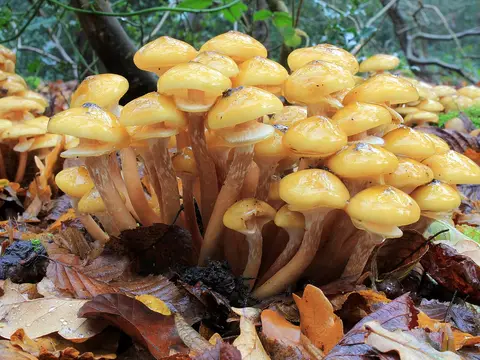 Armillaria mellea | 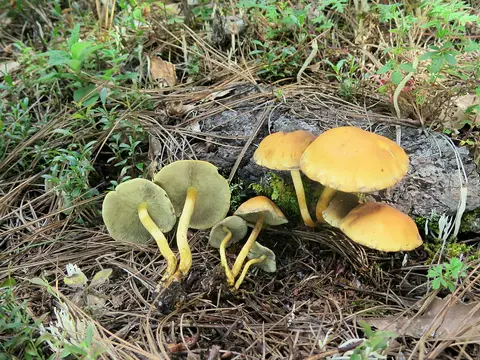 Hypholoma fasciculare | |
|---|---|---|
| Safety status | Edible with caution | Poisonous |
| Cap | Honey-yellow to brown, 4–15 cm, with fine dark scales at the centre | Sulphur-yellow with an orange-brown centre, 2–7 cm |
| Underside | White to cream gills, slightly running down the stem | Yellow, then olive-green and finally purplish-brown gills |
| Stem | Fibrous, with a yellowish ring; black bootlace-like threads (rhizomorphs) grow under bark | Yellow, fibrous, with a fibrous ring zone |
| Smell | Mild, sweetish | Unpleasant, bitter |
| Spore print | White | Purple-brown |
| Habitat | Clusters at the base of living and dead trees and stumps | Dense clusters on dead broadleaf and conifer stumps and logs |
| Season | Sep – Nov | Mar – Dec |
Photos: Stu's Images, CC BY-SA 3.0 · Alan Rockefeller, CC BY-SA 4.0


Quick tests that separate them
- Spore print: white (honey fungus) vs purplish-brown (sulphur tuft).
- Gills: cream (honey fungus) vs yellow becoming greenish (sulphur tuft).
- Under the bark: black bootlace strands (honey fungus).
- Taste: sulphur tuft is bitter, but never taste-test a wild mushroom.
Key clues for each
Honey fungus: White spore print, a cottony yellowish ring and black bootlace threads under the bark. The funeral bell (deadly) has a rust-brown print.
Sulphur tuft: Sulphur-yellow tufts on wood with greenish gills, and a purplish-brown spore print.
Frequently asked questions
How can I tell honey fungus from sulphur tuft?
Both grow in clusters on wood. Sulphur tuft is bright sulphur-yellow with greenish gills and a purplish-brown spore print and is poisonous. Honey fungus is honey-brown with a clear ring, a white spore print and black bootlace-like threads under the bark.
Which is more dangerous, honey fungus or sulphur tuft?
Sulphur tuft (Hypholoma fasciculare) is the dangerous one. Causes severe vomiting and diarrhoea. Rare cases are severe or fatal.
Is it safe to identify mushrooms from photos or a website?
Never eat a wild mushroom based on an app or a website. Confirm identification and edibility in person with a qualified local expert.
Compare in the field
Photograph your find with Mushie to see possible matches and the look-alikes to rule out. Results are suggestions, never a safe-to-eat verdict.