 Mushie
Honey fungus (Armillaria mellea)
Edible with caution
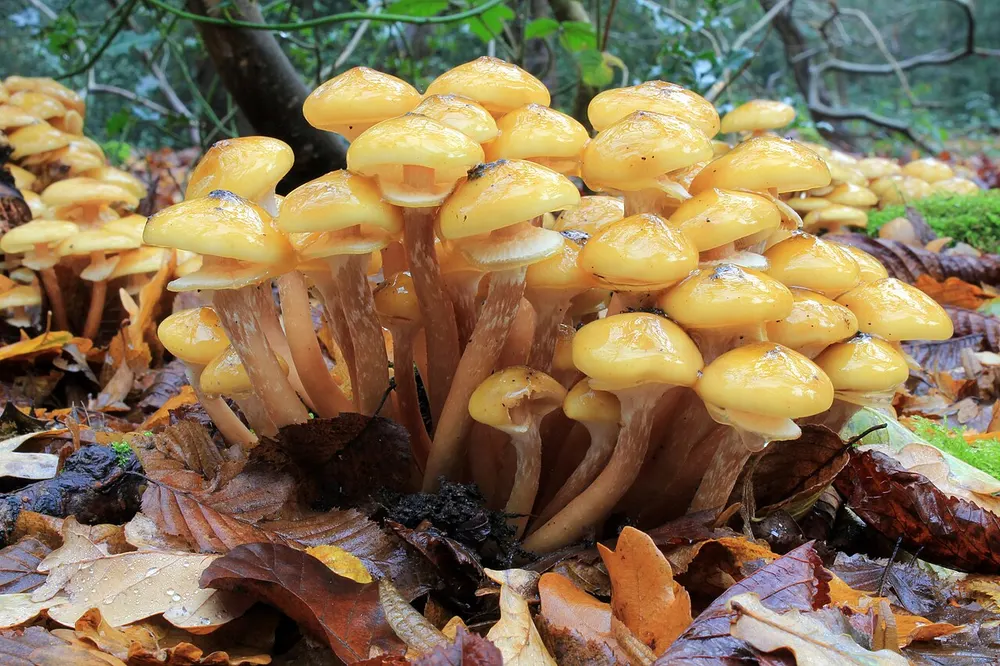
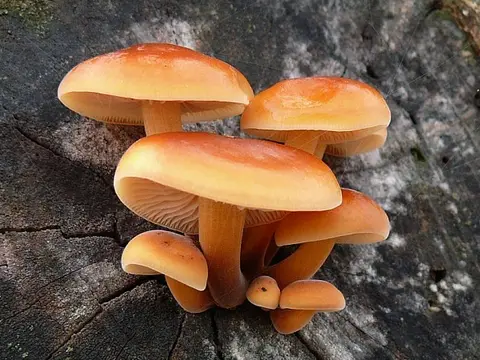
Honey fungus grows in honey-coloured clusters at the base of trees. It needs thorough cooking and has a deadly lookalike on wood.

| Scientific name | Armillaria mellea |
|---|---|
| Other names | Hallimasch · Armillaire couleur de miel · Chiodino |
| Family | Physalacriaceae |
| Season | Sep – Nov |
| Habitat | Clusters at the base of living and dead trees and stumps |
| Range | Northern Hemisphere |
| Spore print | White |
| Smell | Mild, sweetish |
How to identify Honey fungus
| Cap | Honey-yellow to brown, 4–15 cm, with fine dark scales at the centre |
|---|---|
| Underside | White to cream gills, slightly running down the stem |
| Stem | Fibrous, with a yellowish ring; black bootlace-like threads (rhizomorphs) grow under bark |
| Smell | Mild, sweetish |
| Spore print | White |
Is Honey fungus edible or poisonous?
Edible with caution. Edible only when well cooked; raw or undercooked it causes stomach upset. Easily confused with the deadly funeral bell.
Honey fungus look-alikes
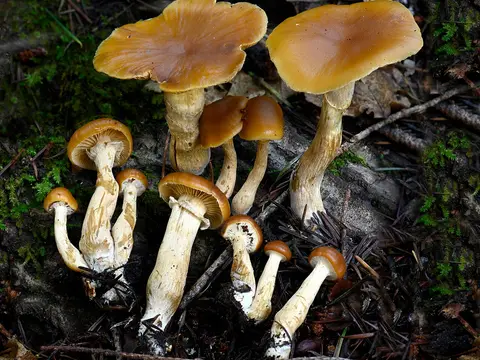
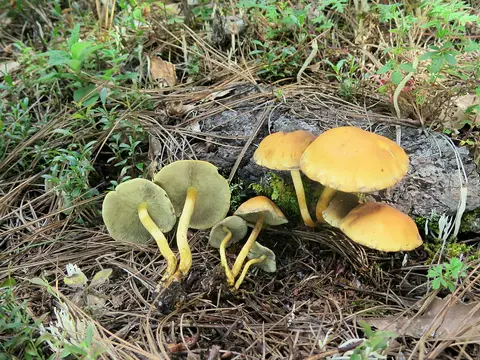
Sulphur tuft and funeral bell also grow on wood.
When does Honey fungus grow?
Honey fungus is typically found Sep – Nov in clusters at the base of living and dead trees and stumps. See other mushrooms in season:
Frequently asked questions
Is Honey fungus edible?
Honey fungus (Armillaria mellea) is regarded as edible only with caution. Edible only when well cooked; raw or undercooked it causes stomach upset. Easily confused with the deadly funeral bell. Never eat a wild mushroom based on an app or a website. Confirm identification and edibility in person with a qualified local expert.
What does Honey fungus look like?
Honey-yellow to brown, 4–15 cm, with fine dark scales at the centre. Underside: white to cream gills, slightly running down the stem. Stem: fibrous, with a yellowish ring; black bootlace-like threads (rhizomorphs) grow under bark.
What are the look-alikes of Honey fungus?
The main look-alikes are Funeral bell (Galerina marginata) and Sulphur tuft (Hypholoma fasciculare). Sulphur tuft and funeral bell also grow on wood.
When and where does Honey fungus grow?
Honey fungus is usually found from Sep to Nov. Habitat: clusters at the base of living and dead trees and stumps. Range: Northern Hemisphere.
Found something like honey fungus?
Photograph it with Mushie for possible matches, look-alike warnings and an AI guide for follow-up questions. Results are suggestions, never a safe-to-eat verdict.
Related species
Sources and credits: written from standard field-guide references. Further reading: Wikipedia: Armillaria mellea. Last updated 2026-10-22. Editorial policy.