 Mushie
Common puffball vs Common earthball: how to tell them apart
Edible puffballs are pure white and soft inside, with a thin skin. Earthballs have a thick, hard, warty yellow-brown skin and firm flesh that is dark purple-black with white marbling. Earthballs are poisonous.
Side-by-side comparison
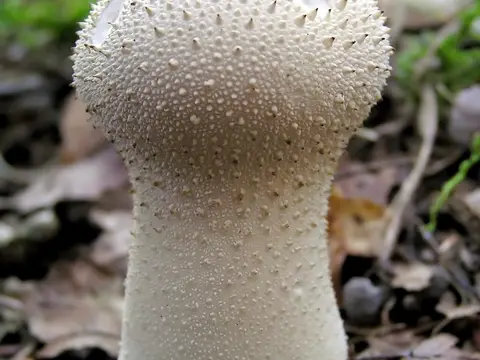 Lycoperdon perlatum | 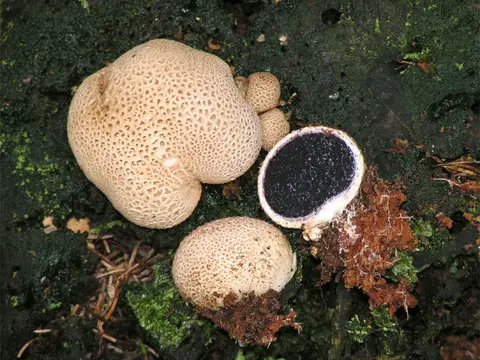 Scleroderma citrinum | |
|---|---|---|
| Safety status | Edible with caution | Poisonous |
| Cap | White to cream, 2–6 cm tall, covered in small cone-shaped spines that rub off leaving a net pattern | Dull yellow to brown, 3–10 cm, thick and scaly or warty skin |
| Underside | No gills | No gills |
| Stem | Short, stalk-like base that is part of the ball | Almost none, or a short, rooting base |
| Smell | Mild, fresh mushroom | Sharp, rubbery or like raw potato |
| Spore print | Olive-brown | Dark purple-brown |
| Habitat | Woodland floor, grass and heath | Acid soils in woods, heaths and lawns near trees |
| Season | Jul – Nov | Jul – Nov |
Photos: Daniel Ullrich, Threedots, CC BY-SA 3.0 · Eric Steinert, CC BY-SA 3.0


Quick tests that separate them
- Cut in half: soft, uniform white flesh (puffball) vs firm dark flesh (earthball).
- Skin: thin, spiny (puffball) vs thick, rough, scaly (earthball).
- Check for an outline: a mushroom shape inside any "puffball" means a deadly Amanita egg.
Key clues for each
Common puffball: Slice it in half from top to bottom: uniform pure white flesh and no outline of a stem, cap or gills inside.
Common earthball: Cut open: the flesh is firm, white with dark purple-black marbling and never uniformly pure white like an edible puffball.
Frequently asked questions
How can I tell common puffball from common earthball?
Edible puffballs are pure white and soft inside, with a thin skin. Earthballs have a thick, hard, warty yellow-brown skin and firm flesh that is dark purple-black with white marbling. Earthballs are poisonous.
Which is more dangerous, common puffball or common earthball?
Common earthball (Scleroderma citrinum) is the dangerous one. Causes gastrointestinal upset. Sometimes mistaken for puffballs, truffles or young Amanitas.
Is it safe to identify mushrooms from photos or a website?
Never eat a wild mushroom based on an app or a website. Confirm identification and edibility in person with a qualified local expert.
Compare in the field
Photograph your find with Mushie to see possible matches and the look-alikes to rule out. Results are suggestions, never a safe-to-eat verdict.