 Mushie
St George's mushroom vs Livid pinkgill: how to tell them apart
Both are large creamy mushrooms that smell of flour. The key difference is the spore print: St George's mushroom has a white spore print and appears in spring, while the poisonous livid pinkgill has a pink print and is found in late summer and autumn. Toxic fibrecaps also appear in spring.
Side-by-side comparison
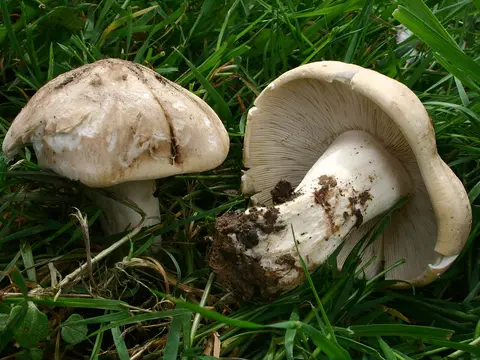 Calocybe gambosa | 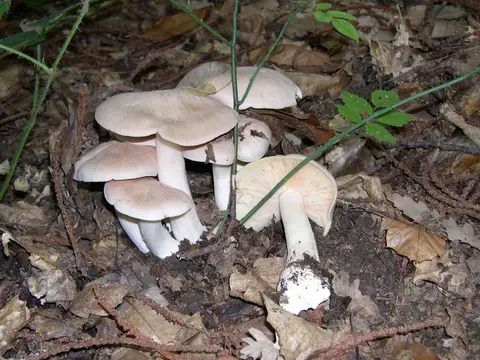 Entoloma sinuatum | |
|---|---|---|
| Safety status | Edible with caution | Poisonous |
| Cap | Cream to buff, 5–12 cm, fleshy, with an inrolled margin | Grey-cream to ivory, 5–20 cm, smooth and silky, often wavy |
| Underside | Very crowded, narrow, white to cream gills | Yellowish at first, then salmon-pink gills |
| Stem | Short, thick, white to cream, no ring | White, stout, no ring |
| Smell | Strongly of fresh flour or cucumber | Floury or rancid meal |
| Spore print | White | Pink |
| Habitat | Grassland, hedgerows and woodland edges, often in rings | Broadleaf woods on chalky and rich soils; often grass near oak and beech |
| Season | Apr – Jun | Jul – Oct |
Photos: User:Strobilomyces, CC BY-SA 4.0 · Archenzo, CC BY-SA 3.0


Quick tests that separate them
- Spore print: white (St George's) vs pink (livid pinkgill).
- Gills: crowded, white to cream vs yellowish becoming salmon-pink with age.
- Season: April to June vs July to October.
- Pink gills mean do not eat.
Key clues for each
St George's mushroom: Appears around late April to May, in rings on grass. White spore print and crowded white gills: a pink spore print means it is not this species.
Livid pinkgill: Pink spore print and gills that turn flesh-pink with age. The smell is like stale flour.
Frequently asked questions
How can I tell st george's mushroom from livid pinkgill?
Both are large creamy mushrooms that smell of flour. The key difference is the spore print: St George's mushroom has a white spore print and appears in spring, while the poisonous livid pinkgill has a pink print and is found in late summer and autumn. Toxic fibrecaps also appear in spring.
Which is more dangerous, st george's mushroom or livid pinkgill?
Livid pinkgill (Entoloma sinuatum) is the dangerous one. Causes severe gastrointestinal illness. One of the most frequent causes of mushroom poisoning in Europe.
Is it safe to identify mushrooms from photos or a website?
Never eat a wild mushroom based on an app or a website. Confirm identification and edibility in person with a qualified local expert.
Compare in the field
Photograph your find with Mushie to see possible matches and the look-alikes to rule out. Results are suggestions, never a safe-to-eat verdict.