 Mushie
St George's mushroom (Calocybe gambosa)
Edible with caution
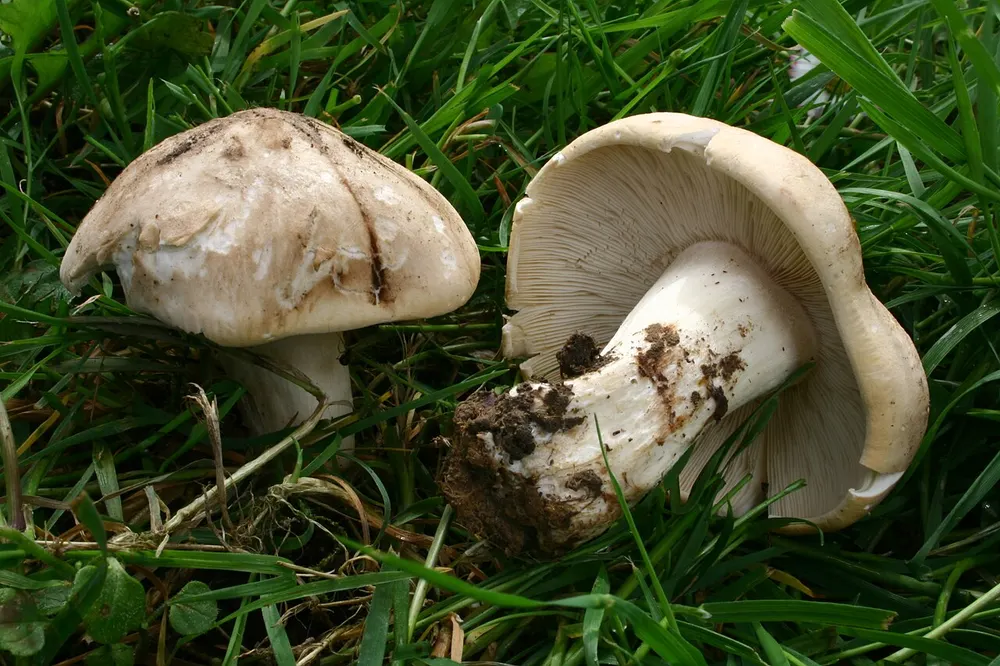
St George's mushroom is a creamy-white spring mushroom that grows in fairy rings and smells of flour. It has dangerous lookalikes.
| Scientific name | Calocybe gambosa |
|---|---|
| Other names | Maipilz · Mousseron de la Saint-Georges · Prugnolo · Mairitterling |
| Family | Lyophyllaceae |
| Season | Apr – Jun |
| Habitat | Grassland, hedgerows and woodland edges, often in rings |
| Range | Europe and western Asia |
| Spore print | White |
| Smell | Strongly of fresh flour or cucumber |
How to identify St George's mushroom
| Cap | Cream to buff, 5–12 cm, fleshy, with an inrolled margin |
|---|---|
| Underside | Very crowded, narrow, white to cream gills |
| Stem | Short, thick, white to cream, no ring |
| Smell | Strongly of fresh flour or cucumber |
| Spore print | White |
Is St George's mushroom edible or poisonous?
Edible with caution. Edible in the opinion of European field guides, but easily confused with toxic spring mushrooms including the livid pinkgill and deadly fibrecaps.
St George's mushroom look-alikes
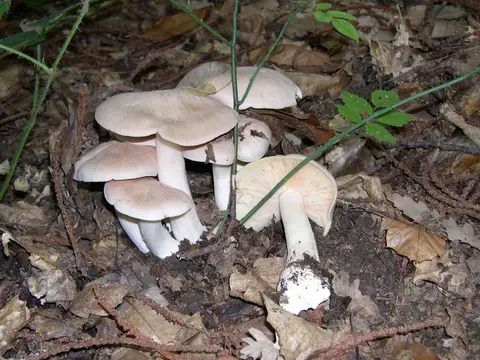
Toxic fibrecaps (Inocybe) also appear in spring and are often found in the same woodland edges.

When does St George's mushroom grow?
St George's mushroom is typically found Apr – Jun in grassland, hedgerows and woodland edges, often in rings. See other mushrooms in season:
Frequently asked questions
Is St George's mushroom edible?
St George's mushroom (Calocybe gambosa) is regarded as edible only with caution. Edible in the opinion of European field guides, but easily confused with toxic spring mushrooms including the livid pinkgill and deadly fibrecaps. Never eat a wild mushroom based on an app or a website. Confirm identification and edibility in person with a qualified local expert.
What does St George's mushroom look like?
Cream to buff, 5–12 cm, fleshy, with an inrolled margin. Underside: very crowded, narrow, white to cream gills. Stem: short, thick, white to cream, no ring.
What are the look-alikes of St George's mushroom?
The main look-alike is Livid pinkgill (Entoloma sinuatum). Toxic fibrecaps (Inocybe) also appear in spring and are often found in the same woodland edges.
When and where does St George's mushroom grow?
St George's mushroom is usually found from Apr to Jun. Habitat: grassland, hedgerows and woodland edges, often in rings. Range: Europe and western Asia.
Found something like st george's mushroom?
Photograph it with Mushie for possible matches, look-alike warnings and an AI guide for follow-up questions. Results are suggestions, never a safe-to-eat verdict.
Related species
Sources and credits: written from standard field-guide references. Further reading: Wikipedia: Calocybe gambosa. Last updated 2026-10-22. Editorial policy.