 Mushie
Oyster mushroom (Pleurotus ostreatus)
Edible (expert ID)
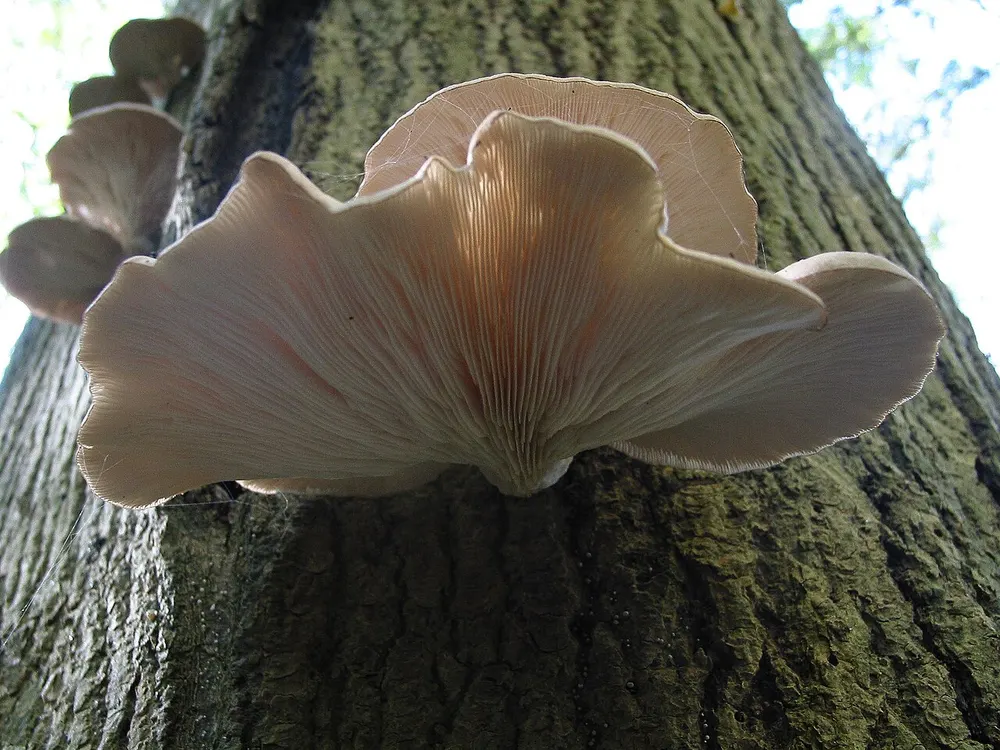
Oyster mushrooms grow in overlapping shelf-like clusters on wood, with grey to brown caps and white gills that run down a short stem.

| Scientific name | Pleurotus ostreatus |
|---|---|
| Other names | Austernseitling · Pleurote en huître · Orecchione · Seta de ostra |
| Family | Pleurotaceae |
| Season | Sep – Mar |
| Habitat | Clusters on dead and dying broadleaf trees, especially beech |
| Range | Europe, North America and Asia |
| Spore print | White to lilac-grey |
| Smell | Mild, faintly of anise |
How to identify Oyster mushroom
| Cap | Grey-brown to blue-grey, 5–20 cm, shell-shaped and smooth |
|---|---|
| Underside | White to cream gills running down the stem |
| Stem | Short, off-centre or absent |
| Smell | Mild, faintly of anise |
| Spore print | White to lilac-grey |
Is Oyster mushroom edible or poisonous?
Edible (expert ID). Regarded as edible when correctly identified and well cooked. Wood-growing shelves in some regions, including a toxic Omphalotus look-alike, need careful checking.
Oyster mushroom look-alikes
Angel wings (Pleurocybella porrigens) are thinner and pure white, and have been linked to serious poisonings in people with kidney disease. In Australia, the ghost fungus (Omphalotus nidiformis) is a poisonous lookalike.
When does Oyster mushroom grow?
Oyster mushroom is typically found Sep – Mar in clusters on dead and dying broadleaf trees, especially beech. See other mushrooms in season:
Frequently asked questions
Is Oyster mushroom edible?
Oyster mushroom (Pleurotus ostreatus) is regarded as edible by field guides when it has been correctly identified and properly cooked. Regarded as edible when correctly identified and well cooked. Wood-growing shelves in some regions, including a toxic Omphalotus look-alike, need careful checking. Never eat a wild mushroom based on an app or a website. Confirm identification and edibility in person with a qualified local expert.
What does Oyster mushroom look like?
Grey-brown to blue-grey, 5–20 cm, shell-shaped and smooth. Underside: white to cream gills running down the stem. Stem: short, off-centre or absent.
What are the look-alikes of Oyster mushroom?
Angel wings (Pleurocybella porrigens) are thinner and pure white, and have been linked to serious poisonings in people with kidney disease. In Australia, the ghost fungus (Omphalotus nidiformis) is a poisonous lookalike.
When and where does Oyster mushroom grow?
Oyster mushroom is usually found from Sep to Mar. Habitat: clusters on dead and dying broadleaf trees, especially beech. Range: Europe, North America and Asia.
Found something like oyster mushroom?
Photograph it with Mushie for possible matches, look-alike warnings and an AI guide for follow-up questions. Results are suggestions, never a safe-to-eat verdict.
Sources and credits: written from standard field-guide references. Further reading: Wikipedia: Pleurotus ostreatus. Last updated 2026-10-22. Editorial policy.