 Mushie
The blusher vs Panther cap: how to tell them apart
The blusher can be eaten if thoroughly cooked, but the panther cap is poisonous. The blusher turns pink to red when cut or bruised and its ring is grooved on top. The panther cap stays white inside, has a smooth ring and a rim at the base of its stem.
Side-by-side comparison
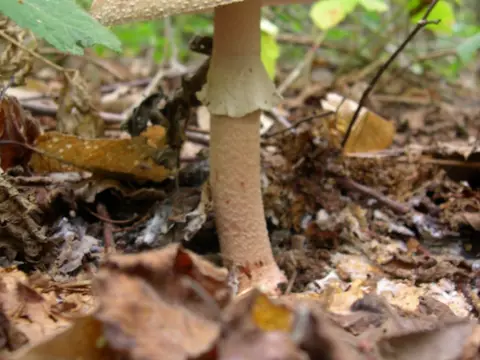 Amanita rubescens | 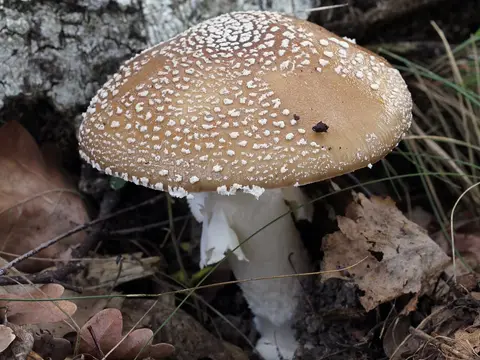 Amanita pantherina | |
|---|---|---|
| Safety status | Edible with caution | Poisonous |
| Cap | Pinkish-brown to reddish-brown, 6–15 cm, covered in greyish to pinkish warts | Brown to olive-brown, 5–10 cm, with small white warts and a lined margin |
| Underside | White gills that develop reddish stains | White gills, free from the stem |
| Stem | Pale, with a ring that is finely grooved on the upper surface, bulbous base | White, with a smooth ring and a rolled, sleeve-like collar at the bulbous base |
| Smell | Mild | Slightly of raw radish or none |
| Spore print | White | White |
| Habitat | Broadleaf and conifer woods | Broadleaf and conifer woods, often on sandy or acid soils |
| Season | Jun – Nov | Jul – Oct |
Photos: Archenzo, CC BY-SA 3.0 · George Chernilevsky, Public domain


Quick tests that separate them
- Cut the flesh: blushes pink-red (blusher) vs stays white (panther cap).
- Ring: finely grooved on top (blusher) vs smooth (panther cap).
- Cap: pinkish-brown with greyish warts (blusher) vs dark brown with bright white warts (panther cap).
- Because of the risk, many guides advise leaving all Amanitas alone.
Key clues for each
The blusher: Flesh slowly turns pink to red where cut, bitten by slugs or bruised. The ring has fine grooves on top.
Panther cap: Flesh stays white when cut or bruised. The ring is smooth (not grooved) and the base has a rim or collar.
Frequently asked questions
How can I tell the blusher from panther cap?
The blusher can be eaten if thoroughly cooked, but the panther cap is poisonous. The blusher turns pink to red when cut or bruised and its ring is grooved on top. The panther cap stays white inside, has a smooth ring and a rim at the base of its stem.
Which is more dangerous, the blusher or panther cap?
Panther cap (Amanita pantherina) is the dangerous one. Contains ibotenic acid and muscimol, like the fly agaric, usually at higher levels. Poisoning is serious and can require hospital care.
Is it safe to identify mushrooms from photos or a website?
Never eat a wild mushroom based on an app or a website. Confirm identification and edibility in person with a qualified local expert.
Compare in the field
Photograph your find with Mushie to see possible matches and the look-alikes to rule out. Results are suggestions, never a safe-to-eat verdict.