 Mushie
Morel vs False morel: how to tell them apart
True morels are honeycomb-pitted and completely hollow. If you cut one lengthwise it is one single empty chamber from the tip of the cap to the base of the stem. False morels have wrinkled, brain-like caps and a cottony or chambered inside. False morels can be fatal.
Side-by-side comparison
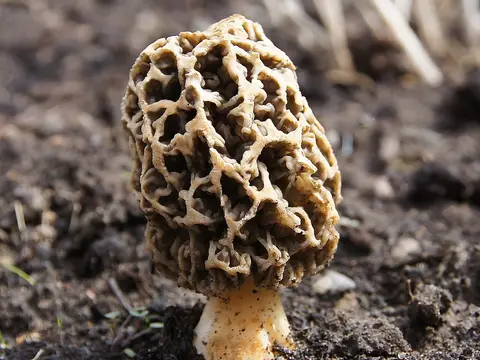 Morchella esculenta | 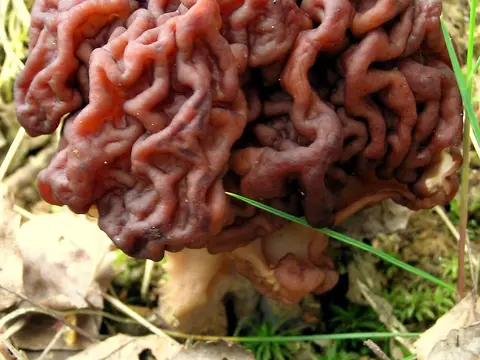 Gyromitra esculenta | |
|---|---|---|
| Safety status | Edible with caution | Deadly |
| Cap | Tan to yellow-brown, 3–8 cm, conical to egg-shaped with deep pits and ridges | Reddish to dark brown, 3–10 cm, irregularly lobed and wrinkled like a brain |
| Underside | No gills: pitted honeycomb surface; the cap is attached to the stem at its base | No gills: folded, lobed surface |
| Stem | Whitish to cream, hollow, continuous with the cap | Pale, thick, chambered or irregularly hollow |
| Smell | Earthy, mild | Mild, fruity |
| Spore print | Pale cream to yellow | Pale yellowish |
| Habitat | Orchards, ash and elm woods, disturbed ground and burn sites | Sandy soils in conifer woods |
| Season | Mar – May | Mar – Jun |
Photos: TOMMES-WIKI, CC BY-SA 3.0 · Wikimedia Commons contributor, CC BY-SA 3.0


Quick tests that separate them
- Slice from top to bottom: completely hollow (morel) vs cottony or chambered (false morel).
- Cap shape: pitted honeycomb (morel) vs brain-like lobes (false morel).
- Attachment: the cap of a morel is joined directly to the stem.
- Both are toxic raw. Never eat either without full cooking and an expert's confirmation.
Key clues for each
Morel: Cut lengthwise: one single hollow chamber from the tip of the cap to the base of the stem. The cap is pitted, not wrinkled like a brain.
False morel: A brain-like, lobed cap on a stem that is cottony, chambered or only partly hollow when cut, never a single clean hollow.
Frequently asked questions
How can I tell morel from false morel?
True morels are honeycomb-pitted and completely hollow. If you cut one lengthwise it is one single empty chamber from the tip of the cap to the base of the stem. False morels have wrinkled, brain-like caps and a cottony or chambered inside. False morels can be fatal.
Which is more dangerous, morel or false morel?
False morel (Gyromitra esculenta) is the dangerous one. Contains gyromitrin, which the body converts into a rocket-fuel-like toxin (monomethylhydrazine). Poisonings and deaths have occurred, even after parboiling.
Is it safe to identify mushrooms from photos or a website?
Never eat a wild mushroom based on an app or a website. Confirm identification and edibility in person with a qualified local expert.
Compare in the field
Photograph your find with Mushie to see possible matches and the look-alikes to rule out. Results are suggestions, never a safe-to-eat verdict.