 Mushie
Chanterelle vs False chanterelle: how to tell them apart
The false chanterelle is not usually dangerous, but it is not tasty and can upset the stomach. It has thin, crowded, true gills that fork repeatedly, a darker orange centre, and a thin hollow stem. Real chanterelles have thick blunt ridges and a firm, solid stem.
Side-by-side comparison
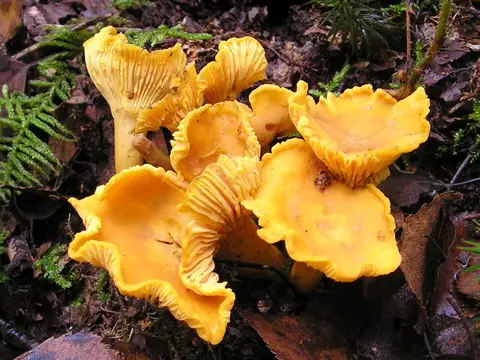 Cantharellus cibarius | 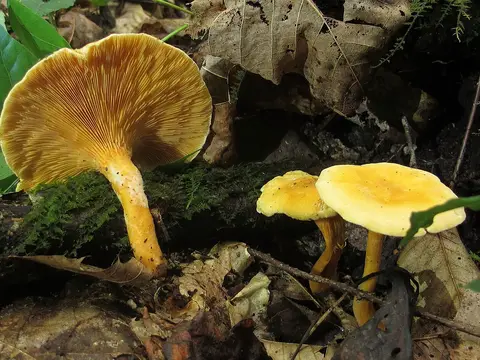 Hygrophoropsis aurantiaca | |
|---|---|---|
| Safety status | Edible (expert ID) | Inedible |
| Cap | Egg-yolk to pale yellow, 3–10 cm, wavy and funnel-shaped | Orange, darker and brownish in the centre, 2–8 cm, with an inrolled margin |
| Underside | Blunt, forked, vein-like ridges that run down the stem (false gills) | Thin, crowded, true gills that fork repeatedly and are deeper orange than the cap |
| Stem | Solid, tapering, same colour as the cap, no ring | Orange-brown, thin, often hollow with age |
| Smell | Faintly of apricot | Mild, slightly mushroomy |
| Spore print | Pale cream | White |
| Habitat | Mossy conifer, beech and oak woods | Conifer woods, heaths and needle litter |
| Season | Jun – Nov | Aug – Nov |
Photos: Wikimedia Commons contributor, CC BY-SA 3.0 · walt sturgeon (Mycowalt), CC BY-SA 3.0


Quick tests that separate them
- Gills: thin, crowded, forking true gills (false) vs thick blunt ridges (true).
- Colour: deep orange gills darker than the cap (false) vs same yellow throughout (true).
- Stem: thin and often hollow (false) vs solid and tapering (true).
- Smell: no apricot scent on a false chanterelle.
Key clues for each
Chanterelle: Blunt, forked ridges that look melted into the stem, a solid stem, apricot smell, growing on soil (never in dense clusters on wood).
False chanterelle: Thin, crowded, repeatedly forking true gills in deep orange, a darker cap centre and a thin stem, usually among conifer needles.
Frequently asked questions
How can I tell chanterelle from false chanterelle?
The false chanterelle is not usually dangerous, but it is not tasty and can upset the stomach. It has thin, crowded, true gills that fork repeatedly, a darker orange centre, and a thin hollow stem. Real chanterelles have thick blunt ridges and a firm, solid stem.
Is either chanterelle or false chanterelle poisonous?
Neither is classed as poisonous, but False chanterelle is inedible. Bland and sometimes causes digestive upset. Not recommended.
Is it safe to identify mushrooms from photos or a website?
Never eat a wild mushroom based on an app or a website. Confirm identification and edibility in person with a qualified local expert.
Compare in the field
Photograph your find with Mushie to see possible matches and the look-alikes to rule out. Results are suggestions, never a safe-to-eat verdict.