 Mushie
Chanterelle vs Jack-o'-lantern: how to tell them apart
Both are bright orange and funnel-shaped. The reliable difference is underneath: a chanterelle has blunt, forked ridges that look melted onto the stem, while a jack-o'-lantern has thin, sharp true gills. Jack-o'-lanterns also grow in tight clusters on wood, chanterelles grow singly or scattered on soil.
Side-by-side comparison
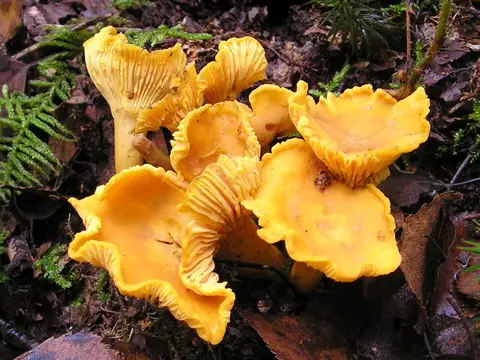 Cantharellus cibarius | 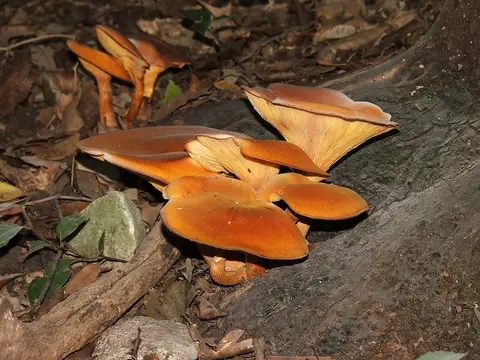 Omphalotus olearius | |
|---|---|---|
| Safety status | Edible (expert ID) | Poisonous |
| Cap | Egg-yolk to pale yellow, 3–10 cm, wavy and funnel-shaped | Bright orange, 5–12 cm, convex to funnel-shaped |
| Underside | Blunt, forked, vein-like ridges that run down the stem (false gills) | True, thin, sharp-edged gills that run down the stem |
| Stem | Solid, tapering, same colour as the cap, no ring | Orange, tapering to a base that joins others in a tight cluster; no ring |
| Smell | Faintly of apricot | Mild, slightly sweetish |
| Spore print | Pale cream | White to pale cream |
| Habitat | Mossy conifer, beech and oak woods | In dense clusters on stumps and buried roots of broadleaf trees, olive and oak |
| Season | Jun – Nov | Aug – Nov |
Photos: Wikimedia Commons contributor, CC BY-SA 3.0 · Antonio Abbatiello, Public domain


Quick tests that separate them
- Look under the cap: blunt forked veins (chanterelle) vs knife-edged gills (jack-o'-lantern).
- Check where it grows: soil (chanterelle) vs clusters on stumps or buried wood (jack-o'-lantern).
- Tear the flesh: chanterelle is pale and stringy; jack-o'-lantern is orange inside.
- Smell it: chanterelles smell faintly of apricot.
Key clues for each
Chanterelle: Blunt, forked ridges that look melted into the stem, a solid stem, apricot smell, growing on soil (never in dense clusters on wood).
Jack-o'-lantern: True, knife-edged gills (not blunt ridges), growing in tight bunches on wood. The gills can glow faintly in the dark.
Frequently asked questions
How can I tell chanterelle from jack-o'-lantern?
Both are bright orange and funnel-shaped. The reliable difference is underneath: a chanterelle has blunt, forked ridges that look melted onto the stem, while a jack-o'-lantern has thin, sharp true gills. Jack-o'-lanterns also grow in tight clusters on wood, chanterelles grow singly or scattered on soil.
Which is more dangerous, chanterelle or jack-o'-lantern?
Jack-o'-lantern (Omphalotus olearius) is the dangerous one. Causes violent vomiting, cramps and diarrhoea, usually for several hours to days. Not normally fatal but a medical emergency for some people.
Is it safe to identify mushrooms from photos or a website?
Never eat a wild mushroom based on an app or a website. Confirm identification and edibility in person with a qualified local expert.
Compare in the field
Photograph your find with Mushie to see possible matches and the look-alikes to rule out. Results are suggestions, never a safe-to-eat verdict.